Sunday, March 16, 2008

New bird discovered in Indonesia


Fri Mar 14, 12:08 PM ET

WASHINGTON (Reuters) - A small greenish bird that has been playing hide-and-seek with ornithologists on a remote Indonesian island since 1996 was declared a newly discovered species on Friday and promptly recommended for endangered lists.


The new species is called the Togian white-eye, or Zosterops somadikartai.

It was first spotted by Mochamad Indrawan of the University of Indonesia and his colleague Sunarto, who like many Indonesians uses one name.

"We observed the species in the field from 1997 to 2003," Indrawan said in a statement.

Dr. Pamela Rasmussen, a taxonomist at Michigan State University, completed the identification, reported in the March edition of The Wilson Journal of Ornithology.

The researchers had to get one of the birds for examination and formal classification.

Togian white-eyes are small, greenish-colored and have conspicuous white eye-rings.

Its nearest relatives have a band of white feathers around their eyes but this energetic little bird, which travels in small groups, is less showy, the researchers said.

The new Togian white-eye has been seen only near the coasts of three small islands of the Togian Islands in central Sulawesi. Rasmussen said it likely falls into the International Union for Conservation of Nature's category of endangered.

"This finding of the bird is only the beginning given the vast opportunities with Indonesian landscapes and seascapes of endemic flora and fauna," Indrawan said.

"What this discovery highlights is that in some parts of the world there are still virtually unexplored islands where few ornithologists have worked," Rasmussen said. "The world still holds avian surprises for us."

Indonesia has 1,600 of the known 10,000 bird species.

(Reporting by Maggie Fox, Editing by Michael Kahn and Jackie Frank)

Tuesday, November 27, 2007

10 minutes with Mel Gibson: When going green comes naturally


NISHA SABANAGAM and FARIDUL ANWAR FARINORDIN

NISHA SABANAGAM and FARIDUL ANWAR FARINORDIN had lunch with Mel Gibson recently during his recent surprise visit to Malaysia. They managed to get the acclaimed Hollywood director to talk about his love for the environment and the rainforest.

Q: How did you become so environmentally conscious?
A: I grew up in a family that was environmentally conscious. My dad had an organic garden. He even had beehives. I have a cattle range, and I make sure we use no pesticides or unnatural products.

Q: Why the focus on the rainforest?
A: I was in awe. Just a few weeks ago I was in the Guatemalan rainforest looking at bugs, thinking ‘What on earth is that?’
I saw some critters I have never seen before. The entomologist I was with said, ‘I don’t know, why don’t we take a picture of it and give it a name?’There are 1.4 million species of insects in the rainforest that they have identified. There are eight-and-a-half million more that they don’t know what to call or what they are good for.It’s not out of the ordinary to have some guy with a machete and a sombrero come out and say ‘Here, eat some of this stuff, it’s really good for diabetes.’ It just goes to show there is amazing untapped potential in the rainforest.

Q: What about your family? Does your family try to live a green lifestyle?
A: I think they’re pretty cool about the stuff, having grown up with that kind of influence. I don’t preach about it. My father never preached to me about being organic. I just really liked what he practised. I thought he was cool. My kids are also pretty cool about it. Had an electric car for a while. Bicycles, walking, all these things are energy savers.Q: What do you think about Malaysia’s rainforest?A: Well, I haven’t really had a chance to see it properly. But I may be going to Danum Valley in Sabah soon. This is only my second visit to Malaysia. The last time I was here was 10 years ago to promote a movie.

Q: Do you have any movies in the pipeline at the moment?
A: There are a lot of different productions in the works, maybe three or four. It takes a long time to get scripts that are really worthwhile. I think, nowadays, a lot of people have forgotten how important it is to have a good story. Computer-generated images and technology seem to be getting bigger. We really need to get back to basics.

Q:Will your stories have environmental messages like Apocalypto which is set during the decline of the Mayan civilisation?
A:I found out that it doesn’t really pay to tell people what you are doing because every time I’ve done that, someone else always tries to do it first. I don’t know why they think I have such great ideas.

Q: It was rumoured that your recent visit to Costa Rica was to scout for locations for your upcoming epic about the 16th Century Spanish explorer Vasco Nunez De Balboa. Is this true?
A: Don’t believe everything you read.

Thursday, November 22, 2007

Rainforest art expo


Rainforest art expo
KUCHING: Over 120 paintings submitted for the Sarawak Rainforest Painting Competition 2007 are on display and for auction at a two-week exhibition which started yesterday.
Organised by Sarawak Tourism Board (STB) and Galleria, a local art gallery, the competition was open to students in two age groups, 12-15 and 16-18, between March and September this year.
The top three paintings in each category will have a starting price of RM50 and the rest RM30 in the auction, with subsequent bids priced at a minimum raise of RM10.
STB chief executive Gracie Geikie called on corporate bodies and organisations to support the event by bidding for the paintings. The proceeds will go to charity.

Idyllic: One of the winning entries on display at the exhibition in Kuching.From a similar exhibition and auction held last year, STB raised over RM2,000 for Salvation Army’s Children Homes, Cheshire Home and Sarawak Association for the Welfare of Orphans.
“We hope to raise more funds this year so that more charitable organisations can benefit,” Geikie said in a statement.
Besides holding the exhibition, STB will reproduce the top three entries in both categories as postcards for use to promote Sarawak overseas.
Some of the paintings will be used as official t-shirt designs for next year’s Rainforest World Music Festival.
The exhibition and auction will be held at Sarawak Tourism Complex from 10am to 5pm daily until Nov 24.

Sunday, May 20, 2007

When forests and inhabitants benefit


When forests and inhabitants benefit

From The Jakarta Post

JAKARTA: When people talk about forest conservation in Indonesia, their discussion is based on a simple equation: forests plus logging equals devastation and the loss of biodiversity. The timber companies have long been considered the number one enemy of the conservation movement, and for good reason. But is it in our best interests for that to continue?

Granted, no one can deny that the timber industry's activities have led to massive forest degradation and loss, and in many places this continues.

Biodiversity suffers whenever forests are cleared. The species found in grasslands and plantations are in no way comparable to those found in primary or lightly disturbed rain forest.

In general, timber concessions rarely follow the plethora of forest management guidelines prescribed in government laws and regulations.

Logging opens up forests, attracting other operators that illegally harvest even more timber, in turn leaving forests vulnerable to fire.

The legacy of decades of “bad” logging in Kalimantan and Sumatra has left, in many places, a degraded landscape. But not all areas were logged heavily, and “good” forest still remains in timber concessions to this day.

The most relevant way to judge logging is to ask firstly, how drastically logging changes forests; and secondly, how it affects wildlife.

Recent work shows that well-managed forestry concessions can actually benefit wildlife conservation tremendously.

Sustainably managed production forests, for example, can provide and maintain valuable habitat for many species that would otherwise disappear if the forest was lost altogether. The key issue is effective management.

The truth is that without some form of recognised management, whether it be by local communities or large enterprises, most of the accessible forests in Kalimantan and Sumatra will be claimed by someone.

The timber will be removed illegally and the forest slowly converted to either agriculture or plantations or, worse, burned and then left as barren grassland.

And it appears that it makes little difference whether these forests have protected status or not. In fact, in some parts of Kalimantan, forests disappear more rapidly from within the protected areas than outside of them.


But how do you ensure that forestry concessions are well managed?

One mechanism is to encourage independent forest certification. Four natural forest concessions in Indonesia have obtained forest management certificates from the internationally recognised Forest Stew-ardship Council (FSC) - three of them within the last year: PT Diamond Raya Timber, PT Erna Djuliawati, PT Sumalindo Lestari Jaya Unit II and PT Intracawood Manufacturing.

But getting certified is a multi-year process that requires significant management improvements. Con-cessionaires must improve management systems, adopt low-impact logging techniques, prove that their timber is both legally harvested and that it can be traced back to its source. They also must have credible environmental management systems in place, including setting aside or specifically managing forests that have high conservation values.

The question, for anyone who knows the industry, is why concessions would voluntarily invest significant sums of money in trying to achieve certification when there is little incentive for them to do so.

But keep in mind that under current business conditions, concessionaires deal with social conflict, security problems, power struggles between different levels of government, conflicting laws and regulations, illegal logging and other forms of encroachment, overlapping land use issues, weak law enforcement, extortion, and, of course, the ever-present KKN (corruption, collusion and nepotism) on the side.

As a result, the cost of doing business is now higher than ever before. And it is not just the big players that are being squeezed; local communities are also feeling the pinch.

Still, one thing is clear. Those companies that have gone down the certification path have done their math. They know how much they invested, but they also know that once they have cleared the certification hurdle, an entirely new market awaits them.

Companies on the front end of the certification wave can expect to receive a significant premium price on their certified timber.

Additional tangible financial benefits also exist such as increases in share price.

The time has never been better to work with the government to drive change, but it must happen now. Recent certification successes in Kalimantan posted by PT Sumalindo Lestari Jaya, PT Erna Djuliawati and PT Intracawood Manufacturing and collaborative management between PT Sumalindo Lestari Jaya Unit IV together with local communities and local government show that these approaches can provide an answer to the problem of Indonesia's disappearing forests and wildlife.


For Another perspective from the Jakarta Post, a partner of Asia News Network, click here

Monday, May 14, 2007

First-ever cataract surgery on orang utan


First-ever cataract surgery on orang utan
By : Annie Freeda Cruez

Email to friend Print article


KUALA LUMPUR: The world’s first cataract surgery on an orang utan will be performed at the Matang Wildlife Centre in Sarawak today.

The orang utan, known as Aman, aged 19, has cataract on both eyes and the operation will be performed on both.

The male orang utan has two female offspring, Mamu, 3, and an unnamed one-month-old baby, living in the centre.

Aman has been suffering from decreasing vision since 2000. In March, animal ophthalmologist Dr Izak Venter was flown in from South Africa to examine it.

Dr S. Sivagurunathan of the Malaysian National Animal Welfare Foundation said the animal was found to have normal retinal function with mature cataract and a decision was made to perform the surgery.
Dr Venter and anaesthetist Dr Frik Stegman, also from South Africa, will perform the two-hour surgery assisted by Dr S. Amilan, a local veterinarian.

Dr Venter, in a report he submitted to the Matang Wildlife Centre, said surgical techniques for animals had progressed and the method to be used is called phacoemulsification.

"This is not laser treatment. During the procedure, a small incision is made in the eye, then the lens is opened and the cloudy contents are removed by a probe."

He said there were situations when a lens could be replaced and in such cases, the eye would remain longsighted and thus Aman might need more time to adapt before it could see better.

The animal’s vision would not be crystal clear, but it would be able to move about and identify objects in front of it.

"Some animals show improved sight within hours whilst others may take several days," said Dr Venter.

Dr Amilan said the surgical team was excited about the operation.

"It will be the world’s first cataract surgery on an orang utan and it is going to be performed on home territory. It will be a big achievement."

All costs for the surgery is covered by donations.

Dr Sivagurunathan said Aman was a charismatic animal and with its sight restored, it would be able to enjoy a normal life.

"His offspring have a real chance to be released back into the wild in his lifetime.

"Aman was rescued from a market in Sarawak in 1989 and kept as a pet for three months before being surrendered in April 1989 and placed at the Semenggoh Wildlife Rehabilitation Centre," he added.

Aman had two serious accidents at the centre. He bit an electric cable and had to have his tongue removed and its left index finger was bitten off by another orang utan in 2000.

Aman has lived at the Matang Wildlife Centre since December 2000.

This centre was opened on July 26, 1998 and has 179ha of land dedicated to the housing and possible release of animals rescued from the area.

Sunday, March 11, 2007

MNS: Release of captive-bred Milky Storks should be carefully planned


MNS: Release of captive-bred Milky Storks should be carefully planned
12 Mar 2007
Mazlinda Mahmood


--------------------------------------------------------------------------------
KUALA LUMPUR: The Malaysian Nature Society (MNS) is concerned with the manner in which captive-bred Milky Storks, locally known as burung upeh, were released recently in Kuala Gula, Perak.

MNS president Anthony Sebastian said introducing captive-bred storks into the wild required careful consideration and planning.

"They need a period of acclimatisation to minimise stress and ensure they can fend for themselves. If the release does not follow proper procedure, they most probably won’t survive," he said.

He was commenting on the way Natural Resources and Environment parliamentary secretary Datuk Sazmi Miah released eight captive-bred Milky Storks (Mycteria cinerea) from Zoo Negara at the Kuala Gula Bird Sanctuary to mark the World Wetlands Day recently.


The storks are on the verge of extinction and are listed as the most endangered bird species in the country.

He said the World Conservation Union has released a set of guidelines in 1995 to counter the risk of releasing captive-bred birds into the wild, which has been adhered to by MNS in the case of the existing captive-breeding programme at the Kuala Selangor Nature Park.

The programme was jointly set up by MNS, Zoo Negara and Wildlife and Natural Parks Department (Perhilitan) in the 1990s where eight birds were reintroduced and are still surviving today.

"We have eight birds living in the wild here and eventually we hope they will breed, and that is a great success for our park," he added.

The global population of Milky Storks is currently estimated to be fewer than 5,000. They can only be found in three countries — Malaysia, Indonesia and Cambodia.

Since the 1980s, the Milky Stork population in Malaysia has dwindled from around 200 to fewer than 10 in the wild today.

Tuesday, March 06, 2007

Telling the hunter’s tale


Telling the hunter’s tale

The indigenous way of honey-gathering is immortalised in a beautiful children’s book.

They are the honey hunters, rural folk who climb the tall trees on which the bees nest, to harvest the sweet honey and beeswax.

They brave vertigo-inducing heights of up to 70m and colonies of 40,000 to 80,000 bees with deadly stings. But they are armed with precious knowledge, techniques and rituals, which have been passed down for generations.


»I fell under the spell of the rainforests, the bees and especially Pak Teh« - DR STEPHEN BUCHMANN
These fascinating hunters are the basis for a beautiful new children’s book published in the US called The Bee Tree.

The book is about the passing down of the honey-hunting tradition to the younger generation, which, among other things, involves climbing a giant Tualang tree (Koompasia excelsa) – the bee tree.

Taking almost a decade to be actualised, the book is the result of a coming together of extraordinary people from different backgrounds.

Authored by Americans Dr Stephen Buchmann, 54, entomologist and environmental consultant, and Diana Cohn, 48, an award-winning children’s book writer and hobbyist beekeeper, it features wonderful artwork by scientific illustrator Paul Mirocha, 52.

A key collaborator in this venture is Datuk Dr Makhdzir Mardan, professor of apiculture and pollination biology at Universiti Putra Malaysia.

It was at an international bee conference at Tasik Pedu organised in 1994 by Prof Makhdzir that Dr Buchmann was introduced to Salleh Mohammed Noor (Pak Teh).

The octogenarian head of a honey hunting clan, Pak Teh has been honey hunting since 1964. One of his credos is that “as long as there is the rainforest, there will be bees, and as long as there are bees, there will be honey, and as long as there is honey, there will be honey hunters.”

Realising this relationship of honey hunting to rainforest conservation, the two scientists therefore decided to write a scientific book on Pak Teh's clan. This evolved into a children’s fiction book because “we need the people in the Pedu Lake area to protect the forest, and children are the best people to whom to get the message across,” said Prof Makhdzir.

Children must recognise these honey-hunters as local heroes and emulate the respect the men have for the rainforest.

This is especially important in light of the impending threats to both the rainforest and traditional honey hunting. “They (children) are the future custodians of the rainforest and the honey gathering culture.”

Dr Buchmann added that The Bee Tree was his way (with Cohn and Mirocha) of “immortalising” the honey hunting experiences, which affected him deeply. “I fell under the spell of the rainforests, the bees and especially Pak Teh, who was the first traditional Apis dorsata honey hunter I had ever met.”

Like Prof Makhzdir, he believed conserving the honey bees involved keeping large tracts of forest and their food plants intact as well as by spreading knowledge of this through education and eco-tourism. Dr Buchmann has authored or co-authored 150 scientific papers and eight books and is active in international pollination research, conservation and policies to protect the world’s pollinators and the plants they pollinate.


- Photo courtesy of Paul Mirocha.
To illustrate the book, Dr. Buchmann roped in Mirocha, who enthusiastically bought into the project after experiencing a honey hunt. After producing the first few drafts of The Bee Tree, Dr Buchmann sought editorial advice from Cohn, with whom he had set up an organisation on public education about pollination ecology and indigenous beekeeping practices.

Cohn, who had produced three other children’s books at that time, recounted, “Steve’s skills were in writing for adults and the story needed so much attention in terms of structure, story arc and character development that it was clear that the story needed to be transformed with a different ‘voice’ and that collaboration was necessary.”

She began by reading as much as possible about the Malaysian honey hunters, at the same time feeling her way into what a believable character would be for a young audience.

When she had a manuscript close to completion, she visited Pak Teh and the honey hunters, witnessing “the deep reverence of the honey hunters and the ceremonies associated with the honey hunt. I was graced with being able to see this ancient tradition.” She thereafter rewrote parts of the story.

Cohn’s agent then set them up with a publisher with whom she had worked, Cinco Puntos Press, who agreed to the very unusual step of accepting a manuscript with an artist. The final product, is proud testament to the hard work that went into it.

Last month, Dr Buchmann, accompanied by Prof Makhdzir and Mirocha, presented a copy of the book to Kedah’s Sultan Abdul Halim Mu’adzam Shah at the Anak Bukit Palace in Alor Star.

Certainly, the effort has pleased both Pak Teh and one of his grandsons who had inherited the tradition, Nizam Mustapha, 28.

“Seronok jugak (I feel happy),” cackled Pak Teh in his thick Kedah accent.

“I’m glad that people are doing this research,” chipped in Nizam. “If people don’t know about this, who knows, in 10 years, all this will be gone.”


The Bee Tree by Stephen Buchmann and Diana Cohn, and illustrated by Paul Mirocha, will be available soon in Malaysia. For more information, email Cinco Puntos Press (www.cincopuntos.com) at info@cincopuntos.com.

Thursday, January 11, 2007

Mystery of world's biggest, yuckiest flower solved


Mystery of world's biggest, yuckiest flower solved By Will Dunham
Thu Jan 11, 3:29 PM ET


WASHINGTON (Reuters) - It's the world's biggest flower, and maybe the stinkiest, too. And now scientists have used genetic analysis to solve the long-standing mystery of the lineage of the rafflesia flower, known for its blood-red bloom measuring three feet (1 meter) wide and its nauseating stench of rotting flesh.


Writing in the journal Science on Thursday, a team of researchers said rafflesia -- discovered in an 1818 scientific expedition to a Sumatran rain forest -- comes from an ancient family of plants known not for big flowers, but for tiny ones.

In fact, many of its botanical cousins boast flowers just a few millimeters wide.

This family, called Euphorbiaceae, also includes the poinsettia, Irish bells and crops such as the rubber tree, castor oil plant and cassava shrub, the researchers said.

Rafflesia's many odd characteristics long had tripped up scientists trying to figure out where it fit on the botanical tree of life. It is sort of a botanical outlaw -- a parasitic plant that steals nutrients from another plant while deceiving insects into pollinating it.

"They really are a funky plant," Harvard University plant biologist Charles Davis, who led the research, said in an interview.

Rafflesia (pronounced rah-FLEEZ-ee-ah) lives inside the tissue of a tropical vine related to the grapevine, with only its flower visible. It is devoid of leaves, shoots and roots, and does not engage in photosynthesis, the process plants use to exploit the energy from sunlight.

Its flowers can weigh 15 pounds (7 kg). They are a blotchy blood red. They smell like decaying flesh. And they even can emit heat, perhaps mimicking a newly killed animal in order to entice the carrion flies that pollinate it.

'TOTALLY FETID'

"They really do look and smell like rotting flesh. They are a totally fetid, stinking, foul kind of flower. It can be totally repulsive to so many of us. But to the flies that visit these things, it's just delightful," Davis said.

There are various species of rafflesia growing on the floor of rain forests in parts of Southeast Asia, with Borneo the center of its diversity, Davis said.

Davis said its lineage dates back roughly 100 million years to the Cretaceous Period, the last act of the Age of Dinosaurs when flowering plants are believed to have first appeared. The researchers determined that over a span of 46 million years, rafflesia's flowers evolved a 79-fold increase in size before assuming a slower evolutionary pace.

Recent efforts to nail down plant lineages have relied on molecular markers in genes relating to photosynthesis, but that was not possible with rafflesia. The researchers had to scour other parts of its genome for clues.

"These plants are so bizarre that no matter where you put them with any group of plants, you're going to have a lot of explaining to do," Davis said. "But what was surprising was that with all of the options available as close relatives, they are nested within this group of plants with absolutely tiny flowers."

Southern Illinois University plant biologist Daniel Nickrent, who took part in the research, said this deeper understanding of rafflesia might aid people keen to develop larger flowers and fruits.

It was discovered on an expedition led by Sir Thomas Stamford Raffles, who founded the British colony of Singapore, and naturalist Joseph Arnold, who died of malaria on the trip.

Saving the tiger


Saving the tiger

The Malayan tiger is in a perilous but not hopeless state. The endangered species needs ample land, food and protection to flourish. Stories by TAN CHENG LI.

THE Malayan tiger was given “totally protected” status in 1976 – it could be hunted as a game species prior to that. But 30 years later, it remains in a perilous state.

Although the Department of Wildlife and National Parks (Perhilitan) insists that tiger numbers, around 500, are not dwindling and still form a viable population, threats have not really eased. Plantations and chainsaws eat away at wild habitats, poachers carry on their slaughter to feed the demand for tiger meat and parts, and we continue putting “rogue” tigers into cages.

If the Malayan tiger is to survive in the wild and avert a fate such as that of the Sumatran rhinos, whose numbers teeter at fewer than 100, they need help.


Tiger pelts and bones seized from a house in Johor Baru in 2003.
Answering the call is a group of government officials, wildlife managers, scientists and conservationists, who recently huddled together for three days at Perhilitan’s Biodiversity Centre in Lanchang, Pahang, to map out our most comprehensive tiger conservation plan – well, most comprehensive because all we had in the past were piecemeal schemes.

A key point that emerged from the meeting is that all is not lost for the Panthera tigris jacksoni. It may be in a perilous, but not hopeless, state.

With improved methods to gauge tiger numbers, a more positive picture has emerged, says wildlife biologist Dr Melvin Gumal. “In the 1990s, we portrayed tigers as being in crisis. But as we get more information, we find that there is potential to say ‘tigers forever’”.

But that hinges on providing them ample land and food, and protection from poachers and farmers. So the workshop ended with a draft plan that centres around these strategies: monitor and protect existing tiger populations in key areas; link up fragmented tiger habitats through forested corridors; eliminate or reduce threats; and minimise the loss of tigers at forest edges due to man-animal clashes.


Tiger refuge

Tiger biologist Dr Kae Kawanishi, whose work in Taman Negara since 1998 revealed a population of 50 to 80 big cats there, is convinced that Malaysia is one country where tigers will survive. Based on available forest habitat and prey species, she says Peninsular Malaysia can harbour some 1,500 tigers.

“The proposed action plan should promote the continued existence of wild landscapes with abundant prey and core protected zones, connected by areas of tiger-friendly rural development and forestry practice,” says Kawanishi.

Because the Malaysian rainforest lacks abundant prey such as the herds of deer seen in the grassy plains of India and Nepal, its tiger densities tend to be low, at one to three animals for every 100sqkm. So to support viable tiger populations, our wild reserves need to be large. And when we protect tigers, we shield all other wildlife.

Kawanishi singles out three “tiger conservation landscapes” or TCL, which are sites big enough and have the best chance of sustaining the species: the Main Range, Greater Taman Negara and the Southern Forest Complex.


Did this tiger, trapped last June, encroach into human territory or did humans encroach into its habitat?
Other forested areas such as state-owned forests, timber concessions, scrubland, riverine forest and agricultural plots, should not be omitted from the tiger protection plan since they too harbour tigers and other wildlife.

To safeguard tigers found outside protected reserves and wildlife sanctuaries, wildlife managers plan to rely on the National Physical Plan (NPP), as it will create the Central Forest Spine, a tract of forest traversing the length of the peninsula. Its function is to link isolated forests with sheltered reserves to form a larger green haven that will ultimately safeguard water catchments and biodiversity.

Although deemed a useful conservation tool, the NPP, however, has yet to prove its worth partly due to poor implementation. It may be a statutory document which must be complied with but state governments have ignored it. For instance, Perak is logging the Temenggor forest reserve, which the NPP listed as an “environmentally sensitive area”.

Furthermore, the document lacks specifics. So, where to place the forested corridors will entail more studies. Also, many forests have been earmarked for logging and development, thus hampering the Central Forest Spine plan.


Keeping tigers at bay

When plantations and livestock farms march right up to tiger country, attacks on humans and livestock – scientists call these “human-tiger conflict” – become inevitable. Three known conflict hotspots are Hulu Perak-Sungai Siput, Jeli-Kuala Krai-Gua Musang and Dungun-Kelantan. In cases of human fatalities, wildlife rangers have had to shoot the animal. Trapped tigers, meanwhile, end up in Malacca Zoo or Taiping Zoo, where they will forever remain captive.

To mitigate such conflicts, Perhilitan and World Wide Fund for Nature (WWF) have worked with villagers in Jeli, Kelantan, and Jerangau Barat, Terengganu, relying on measures as simple as confining livestock in pens at night and keeping estates weed-free so that tigers have no hiding place. But many villages in conflict sites have not benefited from such attention as the projects depend on available funds.

In the long term, keeping plantations away from tiger territories as well as keeping a sizeable buffer between plantations and forests, seem the logical and easiest solutions – but this wise approach to landuse planning remains elusive.

Stressing the importance of buffers, Kelantan Perhilitan director Pazil Abdul Patah says such a zone will help prevent encroachment into wild areas. “Logging roads, for instance, often give easier access for poachers,” he says.

Often overlooked is the role of prey species in tiger conservation. Tigers could be venturing into plantations for their meals simply because the forest could no longer feed them. Their usual prey, the sambar deer and wild boars, could have been overhunted. This may be the case in Jeli, which saw 45 cases of tiger attacks between 1999 and 2004. Camera trapping work by WWF never captured any photos of deer although they are among the more common rainforest mammals.

A shrinking prey base may pose an even greater threat to tigers than loss of habitat and poaching. If tigers cannot feed themselves and their cubs, their numbers will surely plunge. Some studies have suggested that the loss of prey was what decimated the Bali, Caspian and Javan tigers. If indeed the same threat looms over the Malayan tiger, Perhilitan will have to consider ending legal game hunting.


Four of the 22 wild tigers in Malacca Zoo, destined to a life in captivity.
Halt the trade

With the South China tiger population almost decimated, poachers now target Malayan tigers to meet China’s unabated appetite for tiger meat and parts. Laws exist but the illegal trade will stop only when we muster the will to enforce them.

In a survey of 99 traditional medicine shops in the country in 2004, Traffic, a group that monitors the international wildlife trade, found over half offering products purporting to contain parts of protected wildlife, including the tiger’s.

“Many of these actually contain fake tiger products but they are fuelling demand for the real thing,” says Traffic programme officer Chris Shepherd.

Last year, Traffic found restaurants throughout the country serving wild meat, including tiger meat. Shepherd’s investigations in Laos reveal Malaysia to be a major source of wildlife. Dealers there claim to get supplies of pangolins, freshwater turtles, snakes, long-tailed macaques and tiger meat and parts from Malaysia.

Indeed, foreign poachers have been hard at work in our forests and parks. “We have found camps stocked with boxes of food and medical supplies. So you can imagine how long the poachers intend to stay in the forest,” says Perhilitan law and enforcement director Misliah Mohamad Basir.

Countering criticisms of poor policing by Perhilitan, she says scanty information has hampered enforcement work. But with the help of the Army, Perhilitan has nabbed 75 poachers (all Thais except for five Cambodians) since 2002.

Of the 3,612 violations of the Wildlife Protection Act 1972 between 2001 and 2005, only eight related to tigers. It is believed that most poaching goes undetected. Last June, Thai Police in Bangkok confiscated illegal wildlife parts, including the remains of six tigers, from the cargo of a Thai Airways flight from the Thai-Malaysian border town of Haadyai. Could the animals be ours? Misliah says no information could be obtained from Thai authorities.


Plan in action

Because of the multi-faceted threats, tiger survival lies not only within wildlife conservation agencies. Shepherd echoes a common view when he urges for more inter-agency co-operation: “Enforcement agencies other than Perhilitan, such as the Customs, should be vigilant against wildlife smuggling and view it as priority.”

Finally, we should be ruthless when dealing with poachers and violators. “Small fines and penalties aren’t deterrent,” says Shepherd.

The proposed tiger conservation plan reinstates what many know needs to be done to stop the slaughter of the Malayan tiger. But as always, the outcome depends on what exactly is put into action. Meanwhile, many other issues warrant attention: What do we do about tigers kept in zoos, theme parks and private menageries? Should Perhilitan issue permits for displays of tigers in shopping malls? Should we continue trapping “rogue” tigers and send them to zoos?

The future survival of the Malayan tiger hinges on us providing them with more than space, food and protection; we need to respect them as another species on earth, just like us.

How you can help
Support the conservation efforts of MNS, WWF and MYCAT.

Protect tiger habitat by opposing indiscriminate development and illegal logging of forests.

Do not buy tiger parts or products claiming to contain tiger parts or derivatives.

Do not patronise restaurants serving tiger meat or meat from illegally acquired species.

Do not support zoos, private collections or exhibitions that display illegally acquired animals.

Write to the authorities and the press opposing policy decisions that hamper tiger conservation.

Notify Perhilitan (% 03-9075 2872) if you have information on anyone selling or trapping tigers and other protected species, or trading in their parts and products.
Source: Malaysian Conservation Alliance for Tigers (MYCAT)


To learn more about tigers, go to: www.savethe tigerfund.org, www.21stcenturytiger.org, www.tigers.ca, www.felidae.org, www.savethetigerfund.org, www.21stcenturytiger.org and www.tigers.ca.

Monday, January 08, 2007

Dung-Ho

Cover story: Dung-Ho
07 Jan 2007


--------------------------------------------------------------------------------
A young researcher whose heart is as big as the animals she’s determined to save lets JESSICA LIM tag along on her unusual quest.

AFTER months of battling shin-high, leech-filled mud, dense undergrowth, wasps and a kind of poisonous tree sap that breaks skin into raw blisters, the petite girl squatted happily by the treasure she sought.
It was a shimmering, lustrous pile of elephant dung.
"Wow. Very fresh. So nice," said elephant researcher Cynthia Boon as she broke into a smile.

Boon pinched a bit of the human head-sized bolus and sniffed it.
The team whipped out their dung-assessing gear — a GPS reader, compass, measuring tape and identification tag — and began noting how far it was decayed, the size and exact location.
As coming too close to the actual animal is rather dangerous, Boon explained that the team keeps a safe distance and looks out for the next best indicator — its fibrous poop.
The data will be compiled and analysed under the country’s first nationwide elephant survey, called the CITES Monitoring the Illegal Killing of Elephants (MIKE) programme.
It is a Department of Wildlife and National Parks (Perhilitan) and Wildlife Conservation Society Malaysia project, sponsored in part by the US Fish and Wildlife Service.
It will find out how elephants are distributed in Malaysia, paving the way for a sorely needed elephant master plan.
The plan must strike the delicate balance between the needs of elephants and their human neighbours.
And the plan must be hatched soon, says Perhilitan. Nearly one in five wildlife conflicts reported to the department have to do with elephants.
This makes them second only to long-tailed macaques, which account for more than half. The department receives about 730 jumbo-related complaints a year.
"They may not be highest in the number of complaints, but they are definitely the most expensive wildlife conflict to handle," said Perhilitan’s Salman Saaban.
Salman, the senior assistant director of the department’s Biological Diversity Conservation Division, said that the cost of translocating a single elephant was RM41,000.
They have moved 336 elephants since 1974, an average of one per month.
"The truth is, we cannot say whether we’re putting too many elephants in one place. Maybe the area is over-full, we don’t know. That's why we need this study.
"Until this study is done, we’ll just have to translocate ‘problem’ elephants the way we always done."
It has been seven months since porcelain-skinned Boon, 26, traded the cushy comfort of her hometown in Kulai, Johor, for the dank, foreboding jungles of Taman Negara.
The only child of a contractor dad and hairdresser mum, Boon is one of three young women biologists who are leading teams of Orang Asli, local guides and wildlife rangers into the last of our country’s surviving elephant territories.
"They are our iron ladies," said programme co-ordinator Dr Jephte Sompud.
"We had people from all over the world apply for the job. Sad to say, none of the men had what it took.
"But these three, they’ve got the experience, they’ve got the guts and they’ve got the spirit."
The women only come out of the deep jungles once a month. When in there, they're unreachable by phone, exposed to all manner of wild beasts and surrounded mostly by men.
They sleep in tents and toilet is behind any thick clump of bushes.
The other two biologists, Nurul Fatana Samsuri and Nurulhuda Zakaria, both 23, declined to be photographed.
Their parents, confided Nurulhuda, had a tough time coming to terms with the fact that their darling daughters were risking their lives for hairy, trumpeting giants that could trample them without remorse.
In theory, the plan of action is simple.
First, the team asks local folk to point out where the elephants are. They follow the jumbo footsteps closely and take note of where they hang out.
They then take a huge grid map of the park and mark out systematic horizontal lines on areas within the animals' projected home range.
They must walk along these lines and count the pieces of poop they find.
"Ha, ha. That’s in theory," laughed the bubbly Boon.
Those transect lines, so neat on paper, are very rarely that straightforward on the ground.
"There is no trail to follow, and whether it’s a raging river, a 60-degree incline, or an area infested with semut api (fiery fire ants), the team has to take one determined step after the another to cover the two kilometres.
Recently, after a two-day hike into the park from the Taman Negara Merapoh entrance, Boon and her two Orang Asli guides, Mat Daling and Soufi, stood at the base of an almost vertical incline.
According to their predetermined markings on the map, they were supposed to scale it.
Their progress for the past two hours had been slow. The two young locals had worked non-stop, furiously chopping a path through tangled and thorny undergrowth.
Often, all that stood between them and a death-inviting plunge into the ravine below were some scraggly trees which they clung to for dear life.
And now, scratched, muddy, exhausted and not even halfway into the transect, they were stuck.
A detour to the left and right confirmed that the rock face went on indefinitely. An attempt to clamber up the incline brought down a shower of rocks.
And they hadn’t found a single piece of dung.
What more, rain clouds had gathered ominously. Boon’s left big toe-nail, which had developed a persistent fungus from the constant damp conditions, was torn and throbbing.
"It’s all right," said Boon — a phrase that would be repeated many times over the next few days, weeks and months.
She adjusted her cap and glasses and joked: "It’s not wasted. At least we know there are no elephants here. The only reason an elephant would climb up there is to commit suicide."


Jumbo-sized shoes to fill

COMPLETELY blind in one eye, with vision fading fast in the other, the 70-plus-year-old elephant was glad her employers finally gave her the golden trunk-shake.
Towards the end of her working life, the old dame could hardly walk in a straight line anymore. Mountains, once easy walking, now drained her too easily.
Her keepers said they even saw tears in her eyes when she was gently pushed to deliver her services for one more day.
Mek Bunga the guide elephant would have liked to retire much earlier, but she was an expert in her field. There was just too much work to do and no one to do it.
She is the go-between, pacifier and big momma to frisky younger elephants who have been plucked out of their jungle homes and planted in new ones.
When an elephant persistently disrupts villages, the best strategy so far is to sedate them, transport them over miles of land and sea, and help them adapt to a more food-abundant area, said the Department of Wildlife and National Park’s (Perhilitan) Salman Saaban.
The senior assistant director of the department’s Biological Conservation Division said the job needed two trained elephants to sandwich the sedated wild one as it stumbled though deep jungles inaccessible by land transport.
To discourage the wild elephant from finding its way home, the animal is usually transported over bodies of water, like in the Tasik Kenyir area or in the Belum Forest.
Every year, 12 to 14 elephants are translocated.
Now that Mek Bunga the matriarch has been let loose to contentedly chew greens in the Kuala Gandah Elephant Sanctuary, there are only two guides left and they’re both over 60 years old.
And Lokimalar and Che Mek, says Perhilitan’s Siti Hawa Yatim, may have less than a year to go before they find their job too demanding.
"Without these guide elephants, translocation would be impossible. Don’t tell me you want to pull the elephants yourself!" said Siti Hawa, the department's Biodiversity Conservation Division director.
"Besides, the trained elephants also comfort the new one. It will think ‘hey, at least I got gang here’."
The department had relied on Mek Bunga and Che Mek, both Thai elephants, since adopting this strategy in 1976. Indian-born Lokimalar was roped in recently to take the place of ailing Mek Bunga.
A younger elephant from Myanmar, Myan Thon Pian, was thought to be able to fill the gigantic shoes, but the plan didn’t work.
"The senior elephants rejected Myan Thon Pian. We don’t know why. They just refused to co-operate. It’s not that simple."

National Elephant Conservation Centre’s Nasharuddin Othman said it wasn’t easy to come by trained elephants, and training local ones was out of the question.
"In Thailand, they have domesticated elephants for 2,000 years," said Nasharuddin.
"An elephant needs to be tame for at least eight generations before it can be trained to do this kind of work. Our elephants are very wild."
The situation is getting desperate, said Siti Hawa. The department had been trying for one year to get in new ones, but efforts have not been fruitful so far.

Tuesday, November 28, 2006

Lungs of the earth


Lungs of the earth

A senior botanist shares his thoughts on sustainable use of rainforests with HILARY CHIEW.

HAVING spent a good part of his research career in the Amazon jungles, Prof Sir Ghillean Prance does not want to see the world’s largest tropical rainforest disappear.

After the great destruction of the rainforest at a reported rate of 32,500ha a day or about eight football fields a minute in the 1980s and 1990s due to cattle ranching, the onslaught has not subsided.

Like many conservationists, Prance, who was director of the Royal Botanic Gardens Kew between 1988 and 1999, is perturbed by expanding soy plantations in Brazil.

“I’ll be meeting the Brazilian environment minister soon to discuss the impact of soy plantations. I think it’s my responsibility as a scientist to make use of the opportunity to talk to decision-makers and make meaningful intervention,” revealed the botanist during a recent visit to Kuala Lumpur.

Soybean, which originated from China, has taken root in cleared Brazilian forests as farmers have bred appropriate strains. Prance said soy plantation depletes soil fertility after some years, hence more forests need to be cleared for farmers to gain access to fertile land.

He advocates ethno-botany, a branch of botanical studies which acknowledges rainforest dwellers’ knowledge and sustainable extraction of plants.

Instead of cash crop production, he promotes sustainable harvesting of high value, non-timber forest products, such as the Brazil nut (Bertholletia excelsa), an important plant that has brought much-needed socio-economic progress to the interiors of Brazil.

An authority on tropical botany, Prance has led 16 scientific expeditions into various parts of the Brazilian Amazon and is known for his work on the Brazil nut.

His research on the coconut-sized nut uncovered a delicate web of ecological interdependencies. Female Euglossine bees (or Orchid bees), which pollinate the Brazil nut plant, hold one of the keys to the riddle of the species. They mate only with males which have successfully gathered a complete cocktail of scents from several orchid species – all of which grow only in undisturbed forest.

Understanding such interdependencies is vital for the survival of less economically significant species, and in turn conserves the biological diversity of the Amazon.

Brazil nuts come entirely from wild collection and have been touted as a viable species for generating income from a tropical forest without destroying it, if managed properly.

As the scientific director of the Eden Project in Cornwall, England, Prance continues with his campaign to integrate ethno-botany into the bigger conservation scheme to save the Amazon.

“Eden Project works through educating the public on the importance of plants to the world. We have an extension project in the field to stimulate change on the ground and these experiences are shared with visitors. For instance, we promote free trade products which reward the farmers for producing their crops in a sustainable manner that ultimately benefits them economically and ecologically,” he said.

It is not just for sentimental reasons that Prance is disturbed by the current land use pattern in Brazil. It is the role of the Amazonian rainforest in regulating global climate that is of great concern to the botanist who is also looking into the impact of a warmer earth from a botanical perspective.

Scientists have warned that carbon emissions reduce the amount of water vapour, released through evaporation, that feeds the region’s rain clouds.

The destruction of the Amazon might be large enough to change the climate of the rainforest and of the world. Last year, the Amazon experienced its driest year since 1926. Shallow rivers cut off river transportation and emergencies were declared for many interior towns.

Prance noted that the average first flowering date of 385 British plant species has advanced by 4.5 days during the past decade.

“Sixteen per cent of species flowered significantly earlier in the 1990s than previously. These data reveal the strongest biological signal yet of climate change. Flowering is especially sensitive to the temperature in the previous month, and spring-flowering species are most responsive. This will affect both the structure of plant communities and gene-flow between species as climate warms,” he added.

Under Prance, Kew Garden set up the Millennium Seed Bank to collect seeds from species that are threatened with extinction. The vaults now hold 700 million seeds representing 14,000 species from 126 countries. Stored at -20°C, most will last for more than 200 years. Faced with climate change, scientists are beginning to work on adaptation strategies, studying how seed quality varies with changes in climate.

Despite the grim outlook of the state of the earth, Prance is hopeful. He was particularly encouraged by the sight of participants in a cultural parade 2,400km up the Amazon River carrying placards with a green message.

He said environmental consciousness has grown over the years and people understand the significance of protecting the environment. “When more and more people learn about the environment, they can influence policies,” he added.

Thursday, July 13, 2006

Recent expedition reports sighting of wild Sumatran rhino

Recent expedition reports sighting of wild Sumatran rhino
10 Jul 2006
Roy Goh


--------------------------------------------------------------------------------
KOTA KINABALU: A recent expedition to the Tabin Wildlife Reserve in Lahad Datu has lifted hopes for the preservation of the Sumatran rhinos.

For the first time ever, a wild Sumatran rhino was manually photographed while members of the three-week expedition also recorded two sightings and other signs indicating that the rhino’s population may grow if its surroundings remain undisturbed.

The expedition, from June 17 to July 6, was jointly conducted by SOS Rhino, an international organisation dedicated to the protection of rhinos, together with the Sabah Wildlife Department and Universiti Malaysia Sabah.

The findings of the expedition is the second major breakthrough in Sabah this year. Last month, World Wildlife Fund (WWF) - Malaysia and the Sabah Wildlife department announced the first ever photograph of a wild Sumatran rhino taken by motion-triggered camera.

A member of the expedition team, Arief Rubianto, a ranger from the SOS Rhinos' Rhinos Protection Unit of Indonesia, said the team detected seven rhinos.

"Of the seven rhinos detected, three were confirmed males, one female with a young, another female on its own while the seventh rhino was detected but its gender could not be confirmed," he said.

Two of the rhinos were detected visually while the rest were detected by footprints, scratch marks from their horns and droppings. It is estimated that there are at least 15 to 20 rhinos in the wildlife reserve.

"We surveyed about 25 per cent of the area, which is about 120,000ha. I believe there could be more rhinos," said Arief who has been protecting rhinos in Indonesia for the last 13 years.

Arief also believed that the number of rhinos in the reserve would grow up to 30 within the next five to 10 years if the area remains undisturbed.

Meanwhile, Dr MS Thayaparan, a programme officer with the Institute for Tropical Biology and Conservation at Universiti Malaysia Sabah (UMS), who is also SOS Rhino programme officer, said the university and the organisation has worked together in the last five years on conservation studies.

A conservation club is also being planned by UMS to raise awareness of the Sumatran rhinos which is one of the most critically endangered species in the world.

Wednesday, July 12, 2006

Rainforest World Music Festival: Struggling to be heard


Struggling to be heard

By MUMTAJ BEGUM

Except for a few people in the audience, nobody else at the Sarawak Cultural Village understood what singer Nahawa Doumbia from Mali was saying to them in French. What more for the audience to comprehend the lyrics to her songs that are said to be “stories from her life” sung in Bambari (one of the languages in Mali). Yet the listeners – comprising a vast mix of nationalities themselves – gathered for the recent Sarawak Rainforest World Music Festival just couldn’t get enough of the singer and the musicians accompanying her. Nahawa and the four-man band garbed in traditional stitches were the last act of the first night of this festival held in Santubong, Sarawak.

Cries of “satu lagi” and “we want more” did not fall on deaf ears and she complied by playing a song before she bid adieu just minutes shy from the stroke of midnight. Just like so many West African selections at previous editions of the fest, Nahawa was a firm delight.

On stage she is a force to be reckoned with. Not only because her voice is undoubtedly a powerful tool, but her personality tells us that she is truly at home on the stage. Jovial throughout the set, she cajoled the audience to sing along, and yes, in Bambari. She even encouraged members of the audience to come up and dance with her. One music lover fell down to his knees and touched her feet with his forehead worshipping her after he got a chance to share the stage with her.

This contrasted to the unsmiling woman who came to the press conference held 12 hours earlier (last Friday). It is as if the tragedy of how she had to hide her talent when she was growing up still affected her till today. Sitting down, she related her life in a resigned manner.

Of course, a more logical explanation could be that she was just jetlagged, having flown in the day before!

Her life was struck with misfortune a week after she was born; her mother passed away, leaving Nahawa to be cared for by her grandmother.

As translated by the group’s road manager Tom Puechavy, Nahawa told of how her grandmother went around the village called Manankoro looking for a mother who could breastfeed the newborn. In the end, the grandmother was given two cows to provide the milk.

Tragedy ensued.

With a slight smile, Nahawa recalled in French, “The first cow fell into a well and the second one died after a tree struck by lightning fell on it. You can still see the tree even today.” Her grandmother finally found some women to breastfeed her.

During one of her workshops at the fest, Nahawa spoke more about her music and life. Having lived with all these terrible events, she turned them into a heartfelt number titled Djiwe – that brought the workshop to a standstill. While the words do not signify anything to us, the emotion she conveyed in the song came out loud and clear.

Nahawa started singing when she was seven simply for the reason it gave her pleasure. But it was not something that was encouraged in the Wassoulou region (south of Mali). Her grandmother was Muslim and Nahawa’s want to sing was frowned upon. Furthermore, she was not of the right descendant in Mali. (Only the jali, the Manding caste that performs music, became singers). To put a stop to this, her grandmother got a magician to rid Nahawa of this gift. In her 2000 album titled Yaala, there is a song titled Minia in which she sings of a wicked wizard who is after her.

The strict ruling in Mali changed in the 1960s and the government believed that the development of the country could be achieved through music. Hence every two years, a meeting of youths called National Youth Week was organised by the country’s Ministry of Culture and the talented ones could showcase their talents.

She continued, “My friends and neighbours told me that I should take part in this contest.”

She did and, as the saying goes, the rest is history. With a career spanning nearly 20 years, she has slowly gained a steady following worldwide. Her albums are released in France and in Britain; she has put out records under the acclaimed Stern’s Music imprint.

She started her career by singing Didadi music, a rhythm from her village and played by youngsters there. Over the years, she has added instruments and her music and style have evolved with her but the basis of her music remains the traditional Didadi music. Her songs are made of hard issues such as rights of women and children, the conditions of the poor folk and working hard.

At this point of time, the band comprises a guitarist (N’gau Bagayok), Drissa Sidibe on a lute known as kemele n’goni and two percussionists – Al Hassane Sissoko (on djembe) and Mamadou Diarra on dhoundoun). She has eight albums to her name.

Nahawa Doumbia proves, above all, that music truly crosses all the invisible boundaries. And what would be a tragedy is not to see this performer in action.

Wednesday, June 21, 2006

Courts should be tough with them


Courts should be tough with them
15 Jun 2006
LORETTA ANN SOOSAYRAJ Petaling Jaya

--------------------------------------------------------------------------------
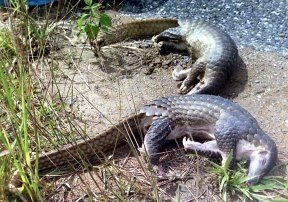
I REFER to the report where two men pleaded guilty to possessing 137 pangolins in Tanah Merah, Kelantan ("Pangolin tra- ders plead guilty" — NST, June 13).

Pangolins are totally protected under the Protection of Wild Life Act 1972.

Sentencing has been fixed for July 14 and the two men risk a maximum jail term of three years, a fine of RM3,000 or both on one charge, a jail term of up to six years, a RM6,000 fine or both on another charge, as well as a separate charge which carries a jail term of 10 years, a fine of RM10,000 or both.

This means that if the court decides to impose the maximum sentences for these two wildlife criminals, they could be behind bars for a total of 19 years each and be poorer by RM19,000.

The laws provide adequate penalties for these criminals. Now it is up to the courts to impose these penalties. For illegal wildlife dealers, even the maximum fines are usually not sufficient punishment.

But long custodial sentences could mean the difference. This will ensure they are physically unable to go back to the business of illegal wildlife trading and they can spend their time behind bars repenting.

And, hopefully, the memory of imprisonment will induce them to never return to their shady dealings once released.

Cruel trade

I REFER to the NST report on the pangolin smugglers. I hope that the two who pleaded guilty to possessing 137 pangolins in Tanah Merah are given the maximum sentence.

Not only did they break the law, they were cruel to animals and upset the balance of nature.

There have been many seizures of pangolins and turtles from Malaysia in Thailand. The animals are always in a terrible state. This cruel trade must stop.

LEONIE VEJJAJIVA

for Wild Animal Rescue Foundation of Thailand

Courts should be tough with them


Courts should be tough with them
15 Jun 2006
LORETTA ANN SOOSAYRAJ Petaling Jaya

--------------------------------------------------------------------------------
I REFER to the report where two men pleaded guilty to possessing 137 pangolins in Tanah Merah, Kelantan ("Pangolin tra- ders plead guilty" — NST, June 13).

Pangolins are totally protected under the Protection of Wild Life Act 1972.

Sentencing has been fixed for July 14 and the two men risk a maximum jail term of three years, a fine of RM3,000 or both on one charge, a jail term of up to six years, a RM6,000 fine or both on another charge, as well as a separate charge which carries a jail term of 10 years, a fine of RM10,000 or both.

This means that if the court decides to impose the maximum sentences for these two wildlife criminals, they could be behind bars for a total of 19 years each and be poorer by RM19,000.

The laws provide adequate penalties for these criminals. Now it is up to the courts to impose these penalties. For illegal wildlife dealers, even the maximum fines are usually not sufficient punishment.

But long custodial sentences could mean the difference. This will ensure they are physically unable to go back to the business of illegal wildlife trading and they can spend their time behind bars repenting.

And, hopefully, the memory of imprisonment will induce them to never return to their shady dealings once released.

Cruel trade

I REFER to the NST report on the pangolin smugglers. I hope that the two who pleaded guilty to possessing 137 pangolins in Tanah Merah are given the maximum sentence.

Not only did they break the law, they were cruel to animals and upset the balance of nature.

There have been many seizures of pangolins and turtles from Malaysia in Thailand. The animals are always in a terrible state. This cruel trade must stop.

LEONIE VEJJAJIVA

for Wild Animal Rescue Foundation of Thailand

Sunday, May 14, 2006

Love your wildlife : What to Know Before Buying a Pet Parrot


How delightful it is to be in the presence of such magnificent creatures as parrots! Their stunning color combinations and attention grabbing mimicry create quite an impression on both young and old alike. Have you been thinking about buying a parrot of your own? Parrots are quite unlike any other pet and they have distinct attributes that make them both loveable and frustrating. Before you choose to own a parrot it is a good idea to familiarize yourself with some of their qualities to ensure that they will fit with your lifestyle. LIFE SPAN Are you planning to commit to a pet for your entire lifetime? While a dog may average 10 to 15 years and a cat slightly longer, some species of parrots live up to 65 or 75 years! That means that not only will the bird live as long as you, quite likely it will survive you and its living arrangements will need to be provided for in advance. Many parrots find themselves in new homes every few years. Despite your loving commitment your bird will likely need a new home when you are no longer able to care for it. You don't want your aged bird to suffer the stress of constantly changing homes so determine what arrangements can be made to satisfy your bird's needs. MESS Birds are messy - no matter what species. Their natural instincts to spread seed throughout the forest has not disappeared and you will need to deal with the seeds thrown out of the cage on a daily basis. Leaving seeds strewn about can attract rodents and become a source of bacteria. Parrots will also produce a fair amount of waste every day. Not cleaning their cages and dishes routinely can lead to infections and is also not healthy for humans. Parrots that are allowed to roam freely can also cause extensive damage to furniture and other items. Large species like the Macaw have a strong bite and can chew furniture, rip wallpaper or knock items over. NOISE While you may find their calls and chattering adorable, your neighbors may not. Different species have different vocalizations. If you live in an attached or semi-attached housing you may have to rule out certain species like Cockatoos which are extremely loud. RESPONSIBILITY Owning a parrot is a privilege and with that comes responsibility. Taking care of your bird does not have to be costly if you clean and feed your bird properly but you will have to invest in proper housing so your bird is comfortable. If you have other pets, such as dogs or cats, you must protect your parrot from being harmed. Never leave other pets alone with your parrot. Many parrots will also develop strong attachments for a certain individual in the family. While the growing loyalty may be appreciated by the favored person it can cause problems when birds become overly protective of their loved one. On the other hand, a parrot is a social and intelligent animal which will become easily bored. A busy home or single owner who has time to give plenty of attention to the bird would be best. Along with people you may find your parrot craves the company of another bird. This is particularly true when the bird matures (around 5-8 years for large species). If you decide to provide a mate for it you must also take responsibility for the increased care and possible babies that may arrive. Parrots bring great joy to the lives of individuals who appreciate them despite the work involved. You owe it to your pet to learn as much as possible about their care so you can commit to them and provide a loving home for as long as possible.
function

Monday, May 01, 2006

New species of parrot, mouse found in Philippines


New species of parrot, mouse found in Philippines

By Alexandra Hudson
MANILA (Reuters) - A brightly plumaged parrot and a long-tailed forest mouse unique to the Philippines have been discovered in the vanishing rainforest of a tiny tropical island, U.S.-based researchers said on Thursday.

Camiguin, a volcanic island in the southern Philippines, is a treasure trove for fauna, and already had an endemic species of rodent and frog before the discovery of the rusty brown mouse and the green hanging parrot, known among locals as "Colasisi."

But Camiguin's wildlife was at risk from deforestation, researchers, writing in "Fieldiana:Zoology", a scientific journal published by the Chicago-based Field Museum of Natural History, warned.

"Knowing that at least 54 species of birds and at least 24 species of mammals live on Camiguin and that some of these animals are found nowhere else on earth, makes us realise how important this island is," said Lawrence Heaney, curator of mammals at the Field Museum.

"For these animals to survive, we've got to save the dwindling forests where they live."

A diverse archipelago of more than 7,000 islands, the Philippines hosts a wealth of endemic flora and fauna but more than 70 percent of its original forests have been destroyed.

Camiguin was once almost entirely covered by rain forest but by 2001, only 18 percent was still forested due to logging, agriculture and human settlement. Half of the island, a popular diving destination, is covered with coconut plantations.

The new species of parrot was known to locals because of its value in the pet trade. The bird's throat and thighs are bright blue and the top of its head and tail are brilliant scarlet-orange.

Males and females have identical plumage, which is quite unusual in this group of parrot, and researchers gave it a new name -- Loriculus camiguinensus or Camiguin hanging parrot.

Little is known about the new species, spurring interests in the scientific and conversation community to establish the size of its population.

The mouse, discovered high on the steep slopes of one of the island's volcanoes, was new to locals.

The rusty-brown rodent, known as Apomys camiguinensis, has large eyes and ears and feeds mostly on insects and seeds.

Sunday, April 30, 2006

Kill the forest, lose cures


Kill the forests, lose cures
By RUBEN SARIO
sario@thestar.com.my
KOTA KINABALU: Compounds derived from plants growing in the Borneo rainforest hold the promise of cures for cancer, AIDS and malaria.
But the greatest fear for scientists is that these jungles are being cleared faster than they can develop the drugs.
“It takes a long time before a substance found in a plant can be developed as an efficient drug and used by doctors,” said Universiti Malaysia Sabah Assoc Prof Dr Menno Schilthuizen.
He authored a World Wide Fund for Nature report on Borneo rainforest plants currently being researched for their medicinal properties.
“I believe that hundreds of plants have been screened, dozens of compounds have been identified but only a few of them are now clinically tested,” added Dr Schilthuizen, who expressed concern over the forest clearing.
His report was recently released in Switzerland.
According to his report, an Australian pharmaceutical company had identified a promising anti-cancer substance in a shrub found in Sarawak.

Monday, April 24, 2006

An eye for beautiful birds


An eye for beautiful birds

WHEN one wakes up in the morning, it is always a pleasure to hear the singing of birds such as the bulbul.
There are lots of birds in Malaysia which are stunningly beautiful and many people had taken to bird watching as an enjoyable pastime.
It is easy to start bird watching. One needs only sharp eyes, a great dose of patience and binoculars.
A good place for bird watching is Pangkor Island in Perak. Toge-ther with some other Malaysian Nature Society (MNS) members from Penang, Perak and Selangor, this writer recently travelled to the island to watch pied hornbills.
The trip was organised by Con-nie Khoo who is fondly known as the ‘Hornbill Lady’. We stayed in the Sunset View Chalets managed by Noordin Bakar who is a great cook and singer.
On arriving at the chalet, we changed into our green pants, shirts and hats. We started trek-king into the forest nearby. Con-nie, who had organised many bird watching trips for MNS members, took a great photograph of two white-bellied sea eagles copulating.

AERIAL ACROBATICS:Pied hornbills snapping up breadcrumbs thrown in the air above them during feeding time.Great patience is necessary to watch birds.
The rainforest track was narrow and the light was fading as we stalked a flashy bird, its piercing calls coming from high on the tree tops, which had eluded us for an hour.
Suddenly there was a movement and in a flashing sweep of yellow and black tail plumes, a crested goshawk alighted on a high branch, allowing a view through binoculars.
“Sshh!” whispered Connie, and we admired its brownish, speckled head and chestnut-coloured body.
Although it drizzled, we were not discouraged and trekked in raincoats. We were rewarded with sights of bulbuls, blue-throa-ted bee eaters, kingfishers and sparrow hawks.
We returned to the chalets and at 6.15pm, Noordin whistled and called for his beloved hornbills.
Loud squawking was heard and some pied hornbills dived in mid air for breadcrumbs.
At 6.45pm, there was a raptor watch.
Raptors, or birds of prey, are among the most spectacular birds in the world. They are highly mo-bile and graceful predators.
In Malaysia, the raptors seen in-clude buzzards, black baza, gos-hawks and sparrowhawks.
It was a joy watching the raptors dancing and frolicking in the sky. Suddenly, Connie gasped and silenced us. She had caught sight of a spotted wood owl in a tree across our chalet. What a delight!
Digiscopes or spotting scopes were focused by the birders and many tourists peeped into the scopes to view the enchanting owl.
The next day after trekking, I swam in the warm sea and saw hornbills on the trees.
Besides bird watching, there are some sights to see in Pangkor. I went on a motorcycle to Teluk Da-lam with another member of the group. There were people drying squids and anchovies in the fishing village.
On the east coast of Pangkor, one can visit Sungei Pinang Kechil. This town has an Indian temple. The Chinese temple and the mini Great Wall of China are worth a look in Sungei Pinang Besar.
There is an old Dutch fort at Teluk Gedung which was built in 1670.

Saturday, April 22, 2006

Happy earth day


The Story of Earthday
Earth Day is in the Spring Every Year.
Earth Day was started in 1970 by a man named John Mc Connell from the United States. It was originally held on the annual celebration of the March Equinox and still is by many people. However, it is generally celebrated on April 22. Earth day is now celebrated worldwide.
Earth Day is a very special day specifically designed for all of us to think about earth issues . It is not only a special day in the town where we live, but a day that the whole world participates in! Often there are celebrations, events or campaigns that concern us with earth matters.


Earth Day is a time to celebrate gains we have made and create new visions to accelerate environmental progress. Earth Day is a time to unite around new actions. Earth Day and every day is a time to act to protect our planet.

amazon